
11 min read
A phone that lasts up to two weeks without a socket, charges your other gear, projects in 2K and sees heat in the dark.
I did a five-day hike across the Finnish tundra, from Hetta to Pallas. There was no electricity along the way, so I carried two power banks, together just under a kilo, and charged two foldable Pixels from them. They lasted exactly the five days.
That’s why I decided to invest in a new prepper phone for the wild.
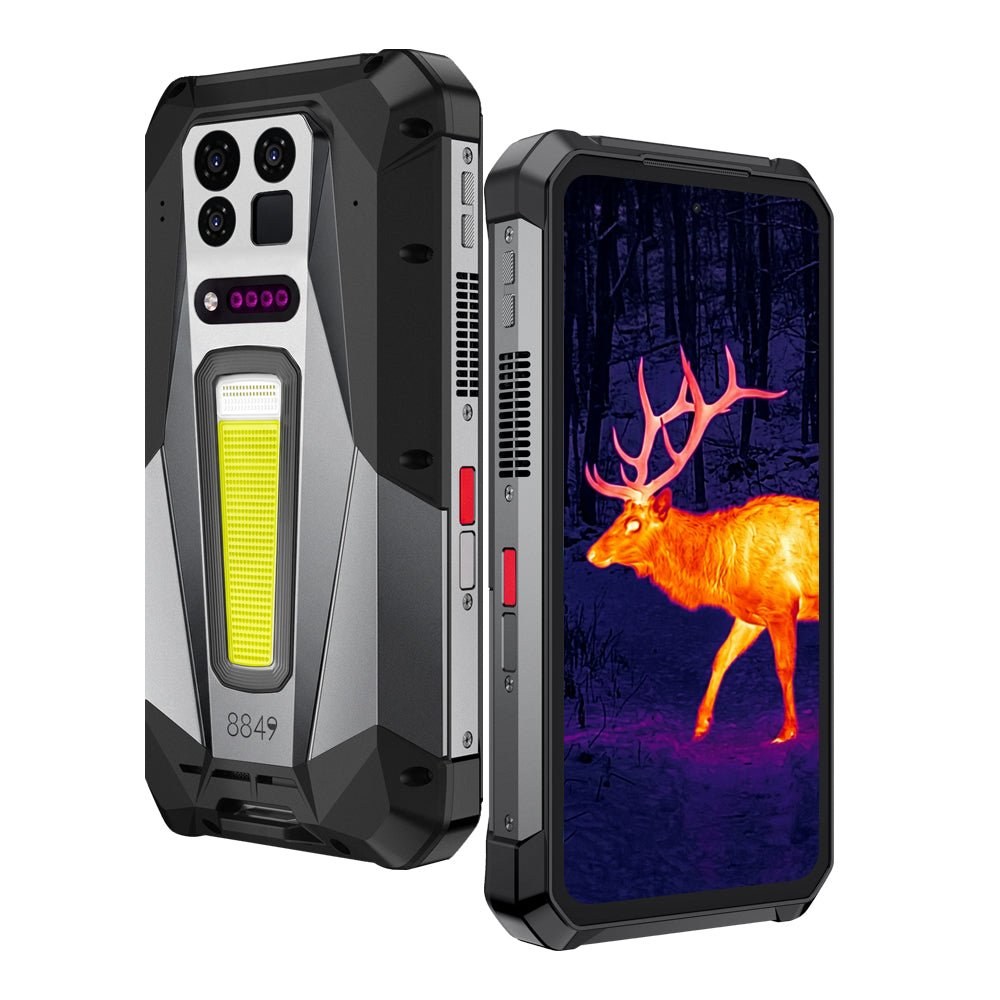
I picked the Tank 5 Pro from the 8849 brand, which is a power bank in its own right. It has a 17,600 mAh battery and can charge your other devices over USB-C. On top of that it packs a 2K projector, a FLIR thermal camera, night vision, a laser rangefinder and a seriously powerful light. The name Tank is no accident: it weighs 715 grams and is 3.4 centimetres thick.
Up to two weeks without a socket
The battery is made of two 8,800 mAh cells, 68 Wh in total. My Pixel 10 Pro Fold has 5,015 mAh, so the Tank carries roughly 3.5 times more energy.
In practice mine lasts one to two weeks on a charge. The manufacturer doesn’t publish a standby figure at all, so I looked for an independent measurement. TechRadar tested the base Tank 5 with the same battery, and in the PCMark benchmark, where the phone works non-stop with the screen on, it lasted 32 hours and 25 minutes. The projector is the biggest energy hog. According to the manufacturer, a full battery is good for 5 hours of projection (6 in night mode), so a two-hour film takes about 40%. If you stare at the screen all day, count on four or five days.
When you do get to electricity, the ultra-fast 120 W charger that comes in the box fills it in about 90 minutes. TechRadar measured 46% in half an hour.
Over USB-C it delivers up to 25 W to other devices, so you can top up a watch, a headlamp, a GPS unit or a second phone. I can charge my Pixel from it about three times, so the power banks can stay at home. And the Tank is lighter than my two power banks from the hike, while also carrying a projector, a thermal camera, night vision and a light.
Cinema on the tent wall
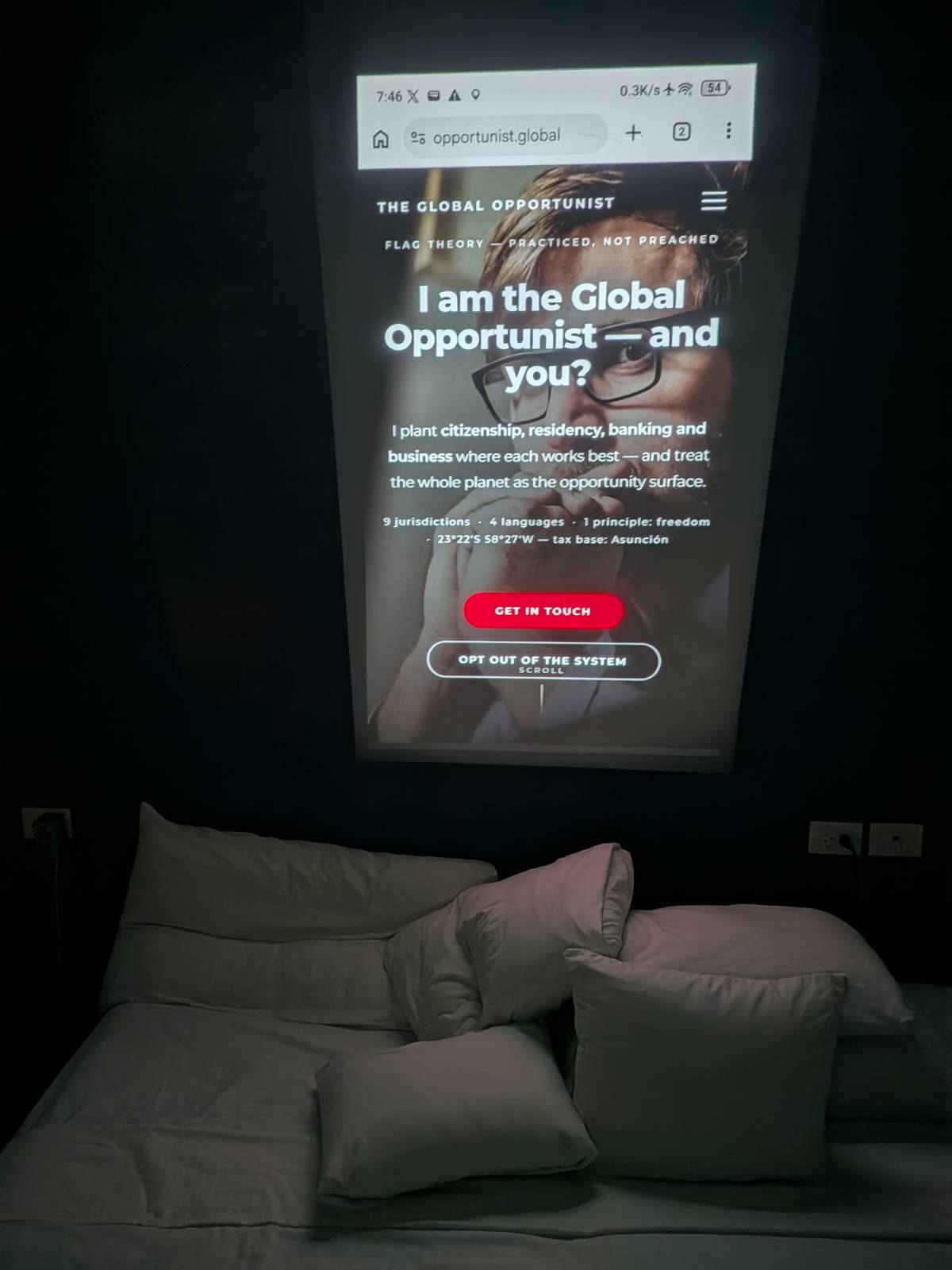
According to the manufacturer, the Tank 5 Pro is the first phone with a 2K projector, and I couldn’t find any projector phone with a higher resolution. Its predecessor, the Tank X, projected in 1080p. 2K here means 2048 × 1080 pixels, which is Full HD stretched slightly wider. The projector uses a Texas Instruments DLP chip with 220 lumens, laser autofocus from half a metre to four metres, and four-point keystone correction of up to 45°. Its lens doubles as a flashlight.
The image on the wall is a couple of metres across, and it really is beautifully clean and sharp. It does need darkness, though. At dusk, in a tent or in a darkened room it’s excellent; in daylight it doesn’t stand a chance. The sweet spot is 1.5 to 2 metres from the wall, and further away brightness and sharpness drop.
Download your films to a microSD card before you leave (the phone takes up to 2 TB). You won’t have signal in the wild anyway.
It hums. What can you do about it?
Yes, it hums. A DLP projector needs active cooling, and the fan kicks in shortly after you switch it on. The noise meter in the Toolbox app, which measures right on the Tank, so right next to the fan, showed me 30 to 31 dB in normal projector mode and 28 to 29 dB in night mode. That’s roughly the level of a whisper. During an action film it doesn’t matter, but during quiet dialogue you can hear it. The fan can’t be switched off, and I found no quiet mode in the documentation or in any review. Here’s what helps:
- Play the sound through a Bluetooth speaker or headphones (the phone also has a 3.5 mm jack) and put the phone behind the audience. The autofocus reaches 4 metres, and every doubling of the distance cuts the fan noise by about 6 dB.
- Switch on the projector’s night mode. It’s dimmer and uses less energy (6 hours instead of 5), but it only makes the fan about 2 dB quieter.
- Keep the vents on the left side and the top edge clear. Don’t put the phone on a sleeping bag or a blanket.
- Don’t charge it while projecting, because charging heats it up even more.
- Blow the vents out with compressed air now and then. The manufacturer’s own page warns that dust and sand can block the fan.
The thermal camera sees heat
The thermal camera is the reason the Pro version exists. The FLIR Lepton 3.1R sensor has a resolution of 160 × 120 pixels. That sounds low, but each of those 19,200 pixels is calibrated and measures the actual temperature from −10 to 400 °C, with a sensitivity below 0.05 °C. The FLIR app upscales the image to 480 × 360 (VividIR) and uses MSX to draw in outlines from the regular camera, so the thermal image also shows edges, lettering and pipes. Its 95° field of view is almost double what thermal cameras in other phones offer, so a single shot covers an entire house wall or the whole area around your tent.
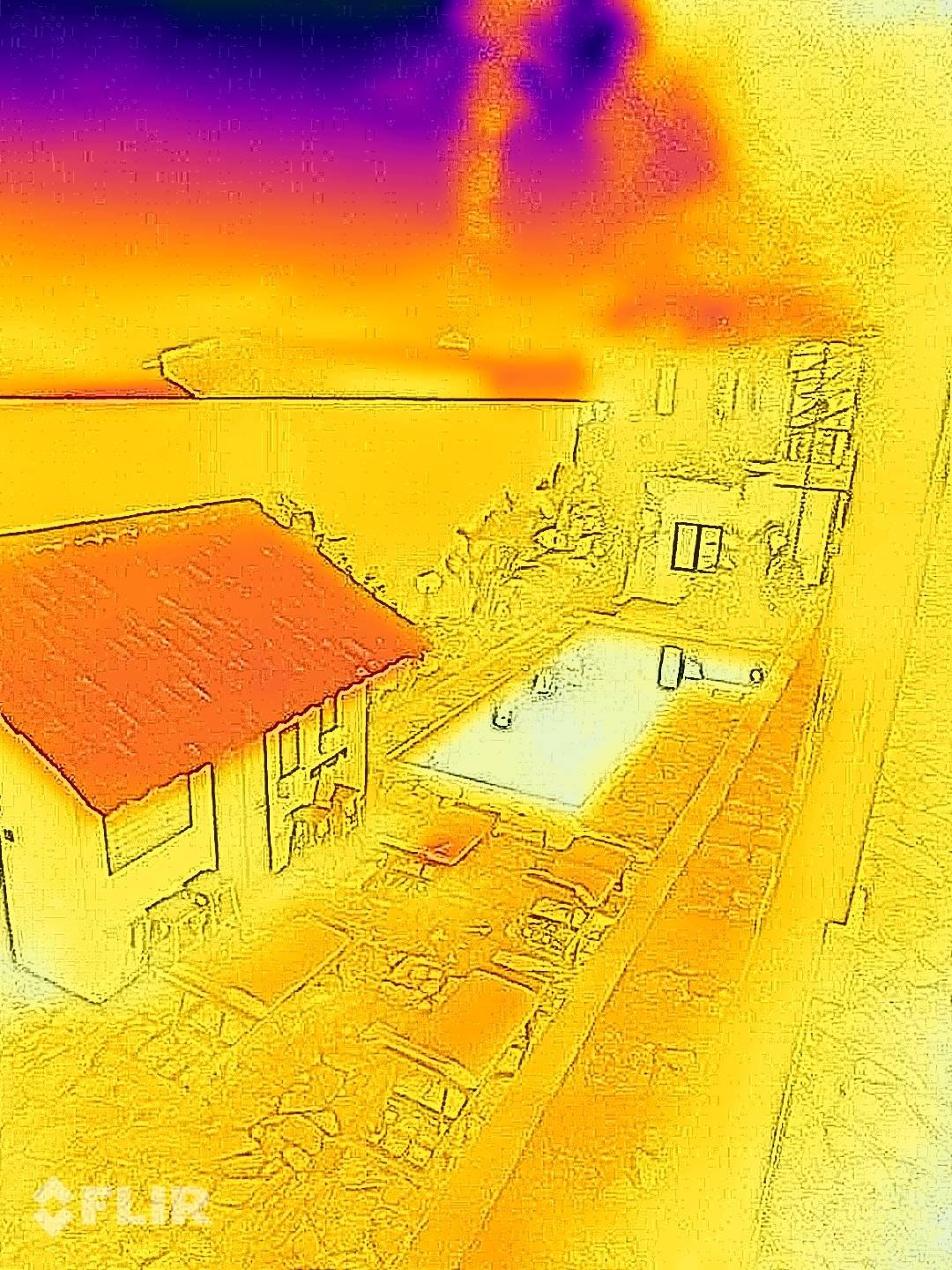
The thermal camera needs no light at all, because it picks up the heat everything around you gives off. At night it shows you an animal in the bushes or a person lost in the forest. Before you leave camp, you can check that the fire pit has really cooled down. At home you can find where heat escapes around the windows, which circuit breaker is overheating, or where the hot-water pipe runs under the floor.
The thermal camera can’t see through glass. Glass is opaque to thermal radiation, and mostly you just see your own reflection in it. The resolution has its limits too. With 160 × 120 pixels spread across 95°, a person standing 30 metres away shows up as a warm blob a few pixels across. It’s excellent for searching and checking, but it’s no rifle scope.
Night vision without a flashlight
The night camera works differently. It doesn’t capture heat, but infrared light from four 940 nm LEDs bouncing off the surroundings. The human eye can’t see it, the 50 MP sensor can. Its range is up to 15 metres and the image is black and white, but far more detailed than the thermal one. You can recognise a face, read a sign, or find the keys you dropped outside the tent at night.
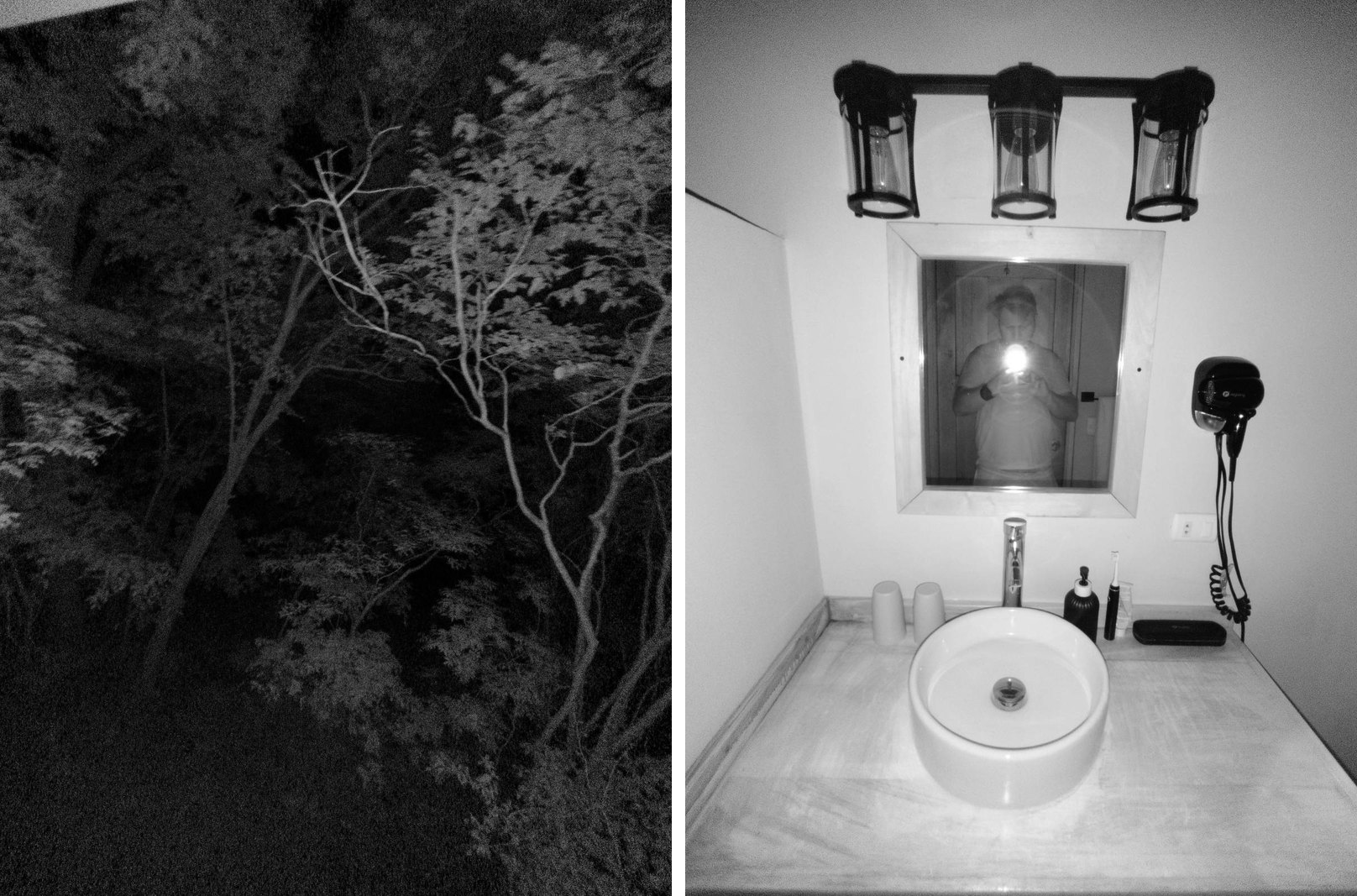
940 nm LEDs are a good choice. Cheap cameras with 850 nm LEDs glow faintly red in the dark, while these are practically invisible to the eye. You won’t dazzle your companions, you won’t ruin your eyes’ adaptation to the dark, and you won’t give away your position. Other infrared cameras, such as trail cams, will still see you, though.
A laser rangefinder instead of a tape measure
The laser that focuses the projector also works as a rangefinder with a 4-metre range. It measures distance, area and volume, and uses Pythagoras to work out a height you can’t reach. When viewing a flat you can quickly get the room dimensions and see whether your bed will fit, and at a campsite whether your tent fits on the flat spot between the trees. It’s not enough for the distance to a deer or a golf hole; for that you need rangefinders that reach hundreds of metres.
Toolbox, light and police siren
The Toolbox app gathers tools you’d otherwise carry in your backpack or hunt for in the app store: a compass, spirit level, protractor, height measurement, barometer, speedometer, magnifier, pedometer, underwater camera and a decibel meter. On the back there’s a brutally powerful light with 1,200 lumens, three brightness levels, an SOS mode and a strobe. On a night walk through a forest or jungle it lights up everything around you.
And then there’s a red-and-blue beacon with a realistic police siren. If you break down on the road it warns other drivers, in the woods it can scare off an animal, and in an emergency it draws attention.
Field hardware
In the wild you’ll also appreciate the bright 6.73″ AMOLED display (up to 3,000 nits), where you can read a map even in direct sunlight, dual-band GPS (L1 + L5) accurate to 1 to 2 metres, a barometric altimeter, IP68 and IP69K protection (it handles submersion as well as high-pressure hot water jets) and an eSIM alongside two nano SIM slots.
A remote for the air conditioning
The Tank also has an infrared transmitter, which will save you money in Latin America. Apartments there are often rented without air conditioning, or with it for a few dozen dollars more. Often it’s the very same room, and the only difference is that if you pay for the version without AC, they don’t give you the remote. With this phone (or a Flipper Zero) you can make your own remote and save 🙂
Apps for the wild
Before a trip I’d install:
- offline maps: Mapy.com (in my opinion the best outdoor offline maps in the world), Organic Maps or OsmAnd, and maps of all of Europe fit on a microSD card,
- Kiwix for the whole of Wikipedia offline,
- Off Grid AI for a local language model (offline LLM). With 16 to 18 GB of RAM it can advise you without any internet,
- MeshCore or Meshtastic for text messages without mobile signal over LoRa radio, across several kilometres. MeshCore watches like the LilyGo T-Watch Ultra, which I wrote about here, can serve as the radio too. With the MCLite firmware they connect to the phone over Bluetooth.
Compared with the Pixel 10 Pro Fold
| Tank 5 Pro | Pixel 10 Pro Fold | |
|---|---|---|
| Weight | 715 g | 258 g |
| Thickness | 33.8 mm | 10.8 mm (folded) |
| Display | 6.73″ AMOLED, 3200 × 1440, 120 Hz | 8″ inner + 6.4″ outer, 120 Hz |
| Chip | MediaTek Dimensity 9400e (4 nm) | Google Tensor G5 (3 nm) |
| RAM / storage | 16–18 GB / 512 GB–1 TB + microSD up to 2 TB | 16 GB / 256 GB–1 TB, no card slot |
| Battery | 17,600 mAh (68 Wh) | 5,015 mAh |
| Charging | 120 W wired (charger in the box), full in ~90 min | 30 W wired (50% in 30 min), 15 W Qi2 wireless |
| As a power bank | yes, 25 W over USB-C | only weakly over a cable, no Battery Share |
| Durability | IP68 + IP69K | IP68 |
| Rear cameras | 50 MP main, 50 MP telephoto, 50 MP night vision, FLIR thermal | 48 MP main, 10.8 MP 5× optical telephoto, 10.5 MP ultra-wide |
| Projector | 2K DLP, 220 lm | no |
| Laser rangefinder | 4 m | no |
| Light | 1,200 lm + red/blue beacon | LED flash |
| 3.5 mm jack | yes | no |
| Satellite SOS | no | yes |
| Updates | 5 years of security updates (manufacturer's promise) | 7 years |
| Price | from $1,149 | $1,799 at launch |
The Pixel is the better everyday phone. It’s two-thirds lighter, takes better photos thanks to its 5× optical zoom and ultra-wide lens, gets seven years of updates and unfolds into an 8-inch display. The Tank is better anywhere without a socket. It carries 3.5 times more energy, charges at four times the power, can charge other devices, and has a projector, thermal camera, night vision and rangefinder that the Pixel lacks.
A Chinese phone with Chinese Android
The Tank 5 Pro is made by the Chinese company Unihertz under the 8849 brand and runs its own version of Android 16. That’s why I didn’t trust it with my password manager, Signal or Threema; those stayed on the Pixel. Otherwise you can run any app on it, and for maps, photos, the thermal camera or films in a tent it’s perfectly fine. If you want to see where the phone sends data, install a firewall such as RethinkDNS or NetGuard. It shows the connections of individual apps, system ones included, and blocks the ones you don’t want. The company promises five years of security updates. Unihertz hasn’t been known for long support so far, so we’ll see.
What it lacks
It sits fine in the hand, you just feel that it’s heavy. It won’t fit in a trouser pocket, so you’ll carry it in a chest pocket, a belt holster or on a backpack strap. The recommended operating temperature is 0 to 35 °C, so in frost it belongs under your jacket and at night in your sleeping bag (that goes for any phone, but with this one you care more about the battery).
The main 50 MP camera is decent, but it can’t compete with the Pixel, and according to TechRadar the Tank 5 can’t even do panoramas or slow motion. It has no wireless charging, and the display is protected by Panda Glass rather than the tougher Gorilla Glass. According to the manufacturer, moisture occasionally condenses inside the projector lens.
It has no satellite communication. The Pixel 10 Pro Fold at least has satellite SOS, which works in Finland too, but the best tool for this is the Garmin Fenix 8 Pro watch with the inReach service. I had it activated on the hike, so I could communicate via satellite as well. When you have no mobile signal, the watch sends a text message or your location via satellite, and the recipient gets an ordinary SMS they can reply to. The watch shows you where to point your wrist, and the message goes out within about a minute. The SOS button calls for help through Garmin Response, a 24/7 emergency centre. The subscription starts at €9.99 a month ($7.99 in the US).
Price and delivery
It isn’t cheap. On the official store it starts at $1,149. Delivery to the EU took less than a week, and I paid no extra customs or tax. If you don’t need the thermal camera, the base Tank 5 without it costs $999.99.
Pros and cons
Pros
- A must-have if you’re going on a multi-day hike or expedition into the wild without electricity.
- If you need a portable video projector, thermal camera or infrared camera.
- If you simply need a “sophisticated” power bank.
Cons
- It’s heavy, weighing 715 grams.
- It can’t run GrapheneOS (which only supports Pixels), so you’re stuck with Chinese Android.
- The projector hums (30 dB) and needs darkness.
- Its photos are worse than those of flagship phones.
- No satellite SOS and no wireless charging.
Conclusion
As a prepper phone for surviving anywhere in the wild, it’s excellent. On my next trip to the tundra it’s coming with me and the power banks are staying at home. I’ll take the Pixel too, for Signal, and for satellite communication I have the Garmin.